
Cellular ultrasonic water meter specifications
Ultrasonic transit-time measurement with no moving parts, a 4G LTE modem with a managed SIM built in, and a lead-free composite body rated IP68.
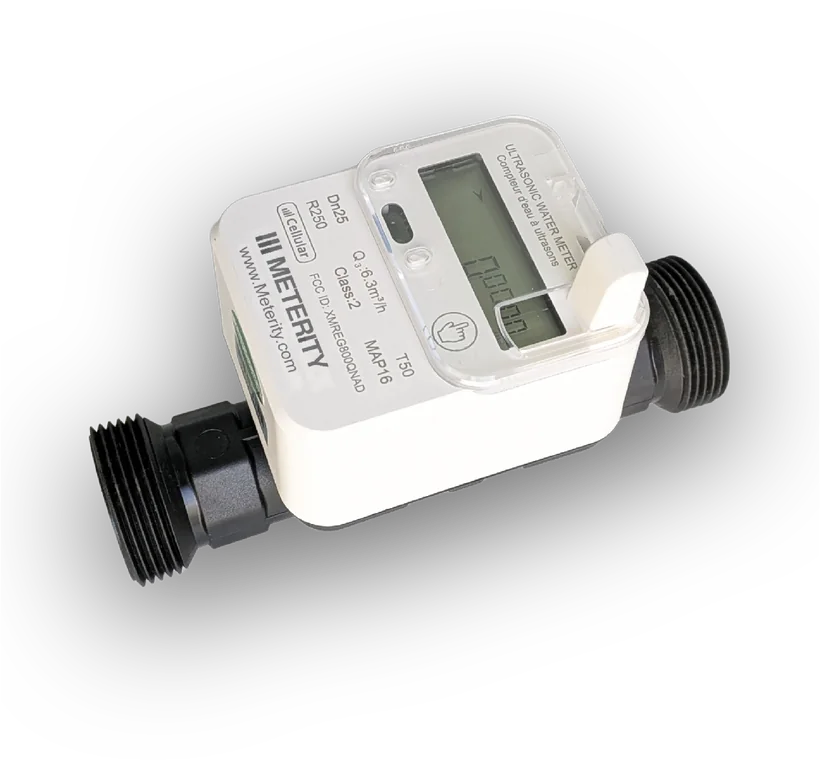
Meter
| Measurement principle | Ultrasonic transit-time, no moving parts |
|---|---|
| Accuracy class | Class 2 (ISO 4064 / OIML R49), as marked on the meter |
| Metrological range | R250 standard · R400 available |
| Sizes | 3/4" · 1" (DN25) |
| Permanent flow Q3, 1" | 6.3 m³/h |
| Typical start flow, 1" | ≈ 4 L/h (1.06 US gal/h) |
| Resolution | 0.0001 m³ (0.1 L) |
| Metering | Two-way, with reverse-flow detection |
| Maximum admissible pressure | MAP16: 16 bar (232 psi) |
|---|---|
| Water temperature | 0.1–50 °C (32–122 °F) · class T30 / T50 |
| Operating ambient | −25 to +55 °C (−13 to +131 °F) |
| Ingress protection | IP68, indoor or outdoor, buried / pit |
| Body | Lead-free composite, potable-safe |
| Installation | Threaded, flow arrow downstream; under an hour per meter once the line is isolated |
| Connectivity | 4G LTE, managed SIM built in |
|---|---|
| Site infrastructure | None: no gateway, repeater, collector, head-end server or site WiFi |
| Data destination | Meterity cloud; web app and phone |
| Battery | Sealed lithium, multi-year service life |
| Reads | Automatic remote reads on a schedule |
|---|---|
| Alerts | Leak and continuous-flow, reverse flow, silent meter, custom consumption limits (daily, weekly, monthly, rolling) |
| Analysis | Per-unit and per-zone ranking, bulk-meter reconciliation |
| Export | CSV and Excel, any period |
Specifications subject to change. Bulk and main-line flanged ultrasonic meters use the same cellular interface; sizes on request.
What engineers ask
Why ultrasonic instead of a mechanical meter?
An ultrasonic meter measures the transit time of sound pulses with and against the flow, so there is no piston, disc or turbine in the water. Nothing wears, so accuracy holds instead of drifting downward as a mechanical register ages, and low flows such as a running toilet are still registered.
How is this different from AMI or LoRaWAN metering?
AMI and LoRaWAN systems need a radio layer between the meter and the data: collectors, gateways or repeaters, power, backhaul and a head-end server. Each Meterity meter talks to the mobile carrier directly over 4G LTE, so there is no infrastructure to specify, house or maintain.
Does it detect reverse flow?
Yes. Metering is two-way, with reverse-flow detection and alerts.
Writing a specification?
Tell us the project and the line sizes, and we will send the datasheet and confirm the right unit.